There’s a moment in the horror movie Solitude when Kara, a contestant on a survival competition show, stares despairingly into her camera and repeats, “I’m going to die out here!”
However, after she looks at her daughter’s photograph, she says, “I’m not going to die out here.” Her resolve strengthened, Kara looks outside her shelter and yells her new mantra defiantly at an unseen monster in the woods: “I’m not going to die out here!”
Seeing Kara use her reason for living to transform into the feisty final girl that had been inside her all along is one hell of a powerful scene.
It’s also the moment that Solitude ups the ante with a propulsive boost from the music of Harry Manfredini (yes, the same one who composed the original Friday the 13th score).
And it’s also the moment I realized Solitude is more than just a spooky romp through the woods. Yes, it wants to quicken the heartbeat with classic horror, but it also wants to pull on the heartstrings with raw emotion. It wants you to feel something.
Now available on Tubi, Amazon Prime and other streaming platforms, Solitude is a gritty low-budget indie feature film that takes the premise of the survival competition TV series Alone and adds a vengeful Native American spirit to the mix.
Solitude is not your typical low-budget indie production because the directors bring a unique and impressive horror pedigree to the project. Jeremy W. Brown directed one of the best fan films ever made with 2019’s Friday the 13th: Vengeance, while Mick Strawn is a legendary production designer with a background steeped in horror movies like A Nightmare on Elm Street 4: The Dream Master, Leatherface: Texas Chainsaw Massacre III, Candyman, and Blade.
THE PLOT
Solitude opens with a Native American definition of the wendigo: “a person who has been transformed into a monster by the consumption of human flesh.”
The plot follows Kara after she is cast as one of ten competitors on a popular survival TV series. She’s isolated in a location with a tragic history, but she is poised to win the competition if she can hold on till the show’s staff arrives to retrieve her. That’s easier said than done.
Sam Wren Vincent immerses herself into the character of Kara, playing the young woman with the tenacity of a classic final girl but with an emotional vulnerability that belies her inner strength. And she can scream with the best of Scream Queens.
While Kara boasts an arsenal of survival skills at her disposal, her confidence and hunger take a hit on day eleven when she discovers the bait removed from her snare traps without ever being tripped. Kara then finds an old journal written by a man from 1811. It details the struggles of the man, his wife, and daughter during a cross-country trip in frigid weather conditions.
Using effective black-and-white flashback scenes, the journal describes the harrowing experience of the family as they battle hunger and starvation. The parallels between the family dealing with hunger and having a young daughter are powerful links to Kara’s own life and situation. This is where the writing by Jeremy W. Brown, Stacy Brown, and T.C. De Witt again elevates Solitude above typical low-budget indie fare. The writers not only connect the hunger and mother parallels, but they also add another layer of depth by weaving the theme of transformation into both past and present storylines.
As the story progresses, Kara’s hunger starts to affect her mind. She finds dead animals in her traps, but their carcasses look like they’ve been decomposing for months even though she just checked the traps yesterday. Impossible, right? We assume there’s a monster (aka wendigo) in the woods stalking Kara because Kara thinks there’s something out there. However, her mental state is deteriorating as hunger and isolation take their tolls. Is she a reliable narrator? Is it all in her mind?
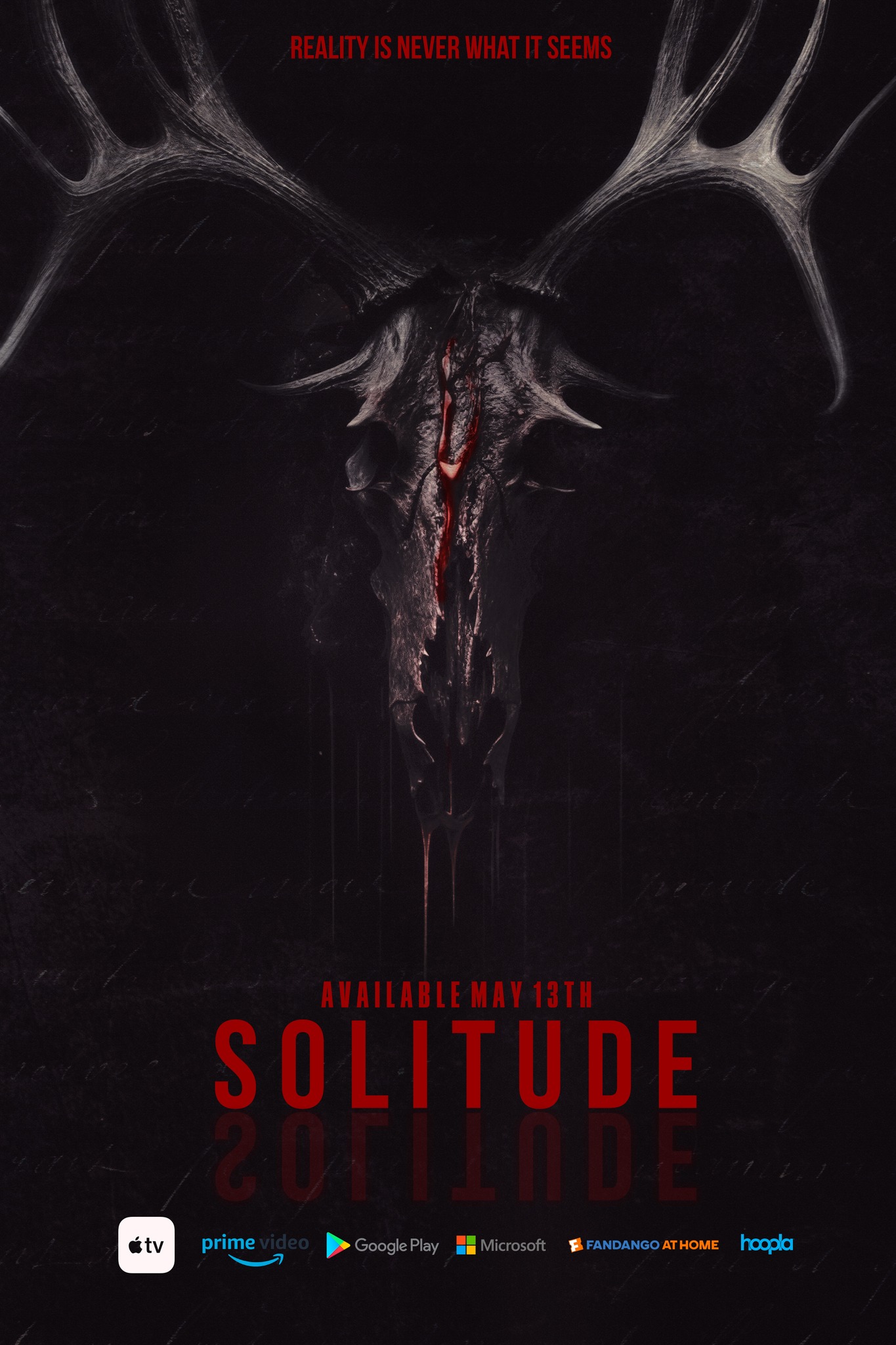
Vincent’s portrayal of Kara’s physical and mental decline is so realistic that it seems plausible. That’s the genius of Solitude. As the tagline on the poster reads: “Reality is never what it seems.” Kara hears menacing sounds in the woods and feels like she’s being watched, but we never actually see a monster for most of the film. When we finally do, I wondered: Is it even real? Am I watching psychological horror, a creature feature, or both?
SPOILER ALERT!
Without revealing too much, I will say that we’re in the hands of Jeremy “Vengeance” Brown and Mick Strawn whose four-decade career includes production design on Freddy Krueger and Leatherface films. So, whether the monster is real or not, you’re going to see a monster – and what a beautifully terrifying one it is.
If watching gritty outdoor survival horror is your bag, Solitude is worth a watch. The perceptive writing gives meaning to the monster. The experienced direction gives meaning to the shots. And Vincent’s passionate performance gives meaning to the main character. It all adds up to an intensely entertaining psychological creature feature with a surprisingly emotional gut punch of an ending.
 LIONEL RAY GREEN